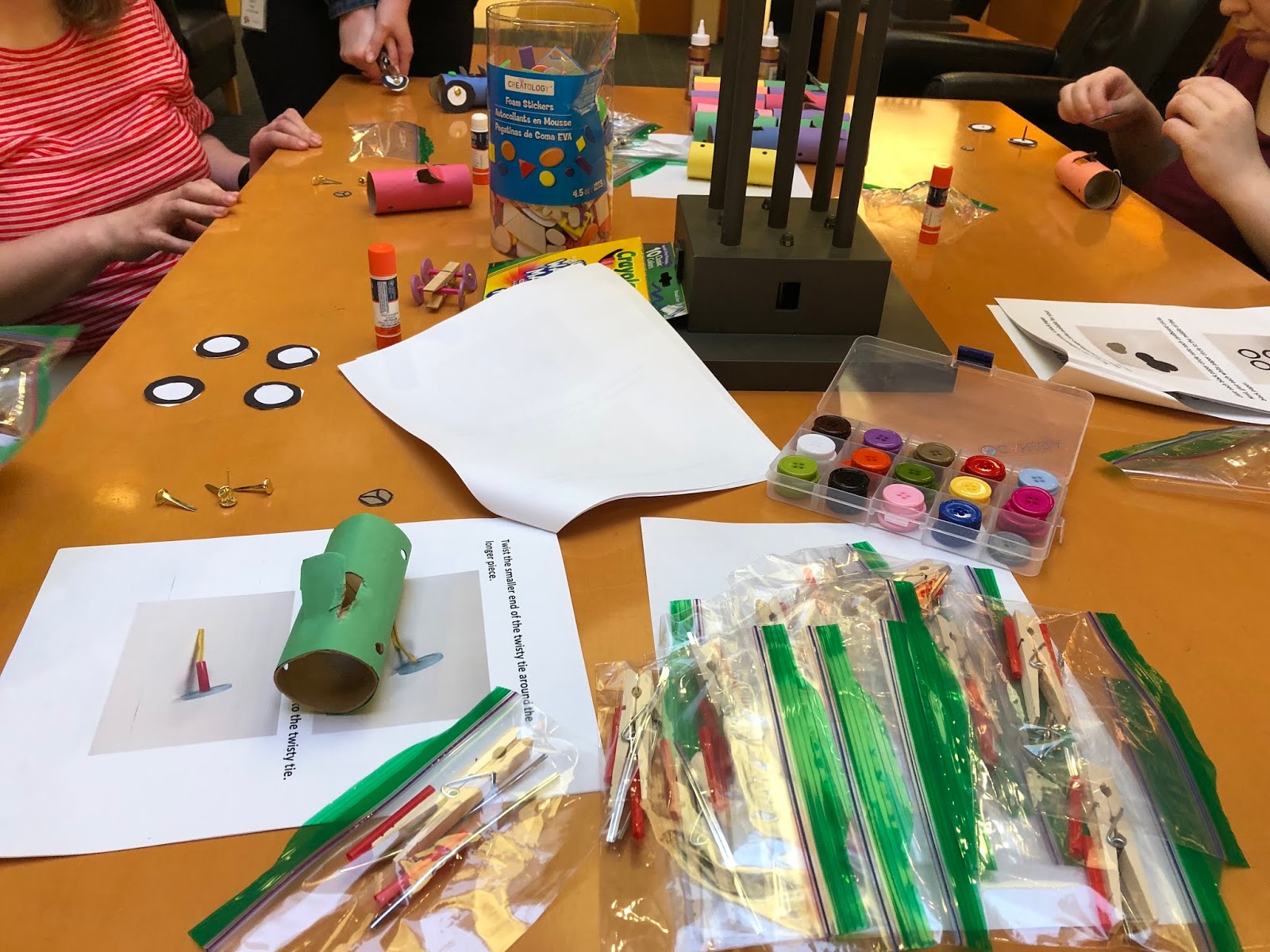
I would like to introduce you to my co-blogger, Ed Niemchak! Ed is an adult services librarian at the Bloomfield Township Public Library. Three years ago, Ed and I worked together to develop a sensory story time for teens and adults after seeing many group home visitors in the youth room looking for things to do during their library visits. We took elements from my sensory story time for youth and added more age-respectful elements, including fiction and nonfiction picture books with age-respectful illustrations/photographs and a social element at the start, discussing the theme with the group. Ed and I also collaborate on our outreach visits to the Wing Lake Developmental Center for students, ages 3 - 26, with multiple disabilities. Take it away Ed!
Going forward, I will talk about current programming in this space, but first I want to reflect on my first program and things I learned, both positive and negative.
The first program I conducted was in January 2016 and it was rushed because my department head didn't want me to procrastinate. Unlike now, I didn't have the layout well defined and hadn't settled on all of the elements that we utilize now.
The theme I settled on, because of the time of the year was "Animals in Winter." It seemed to be a good topic with all of the snow on the ground and would give us a good chance to discuss a few different things.
We now use a variety of elements including a yoga pose, stories, rhymes, songs, music, videos and a craft activity, but due to the rushed nature of the first program we simply read two stories sang a couple of rhymes and had a simple sensory activity.
The books I chose to read were Bear Snores On by Karma Wilson and Over and Under the Snow by Kate Messner.
Bear Snores On tells the story of a group of animals that gather in the cave of a hibernating bear to throw a party. The reason I selected this story is it has a nice rhythm that is easy to follow and also offered the opportunity for us to discuss what the different animals are and what they do in the winter. The illustrations are very colorful and are appropriate for this audience.
Over and Under the Snow is a non-fiction title for youth that introduces a number of animals and how they survive the harsh winter months in the woods, both above and below the snow.
The rhymes we recited were:
Build A Snowman (to the tune of Oh My Darling Clementine)
Build a snowman,
Build a snowman,
Build a snowman,
Big and round.
Shape three snowballs, different sizes
Stack them tall, then add a face.
Dress the snowman,
Dress the snowman,
Dress the snowman,
Big and round.
Dress him in last winter's clothes,
Tie his scarf and add a cap.
When the sun,
When the sun,
When the sun
Shines so bright,
Watch him melt and disappear
Never to return again.
Save his clothes,
Save his clothes,
Save his clothes,
Don't throw them out!
Soon the snow will fall again.
Another snowman will be born.
The Frost Song (to the tune of Farmer in the Dell)
The frost is in the air.
It's wintertime, It's wintertime,
The frost is in the air.
The frost is on the trees.
It's wintertime, It's wintertime,
The frost is on the trees.
The frost is on the roof.
It's wintertime, It's wintertime,
The frost is on the roof.
The frost is on the windows.
It's wintertime, It's wintertime,
The frost is on the windows.
The frost is on the ground.
It's wintertime, It's wintertime,
The frost is on the ground.
The frost tells me it's cold.
It's wintertime, It's wintertime,
The frost tells me it's cold.
So inside I'll stay.
Inside it's nice, and I am warm.
So inside I'll stay.
For our sensory activity, I found fake snow called "insta-snow" and a variety of Toob animals. I selected both animals that are and are not found in snow and buried them in the insta-snow. The participants dug up the animals and we discussed the feel of the snow as well as whether the animals are typically found over, or under, the snow.
What Did I Learn?
I had a few challenges with my first program, partially due to the fact that I wasn't entirely sure what I was doing or if anyone would show up. As it turned out, we had seven folks with 2 caregivers. Not too bad for a first time.
One of the first challenges we faced was getting folks into our meeting room in the basement. Many of the folks have trouble with stairs, and our elevator only holds so many, so we spent a great deal of time getting everyone down. To remedy this, after our first three programs, I have been able to consistently book the library's upstairs room, making it easier on all involved since our program attendance has increased greatly.
Another challenge I faced was the ability of everyone to see the book we were reading. I would spend much time walking around the room to show the pictures, while at the same time trying to be as descriptive as possible for our low-vision guests. After discussing with Jen, we realized with the option to use the projectors in each room, I now scan in the books to a PowerPoint slideshow, or, more recently, attempt to find appropriate books on Hoopla.
The last challenge I faced that day was trying to sing out the rhymes, when no one else could follow along. It was suggested that in the future, which I still do now, that we make copies of the rhymes and handout them out to anyone else that wants one, including attendees and caregivers.
After the first few programs, I started to receive feedback from caregivers as the attendance started to grow. What they asked for are things that have become regular elements of the programs, including a yoga stretch at the beginning as well as more animated rhymes with movement to attempt to get the attendees moving around and more engaged.
In future posts, I will discuss more current program themes that I have explored but for now wanted to reflect back on where it all started.
Saturday, June 22, 2019
Wednesday, May 22, 2019
ArtABILITY: Accessible After-Hours Discovery at the Library
I love the month of May because that means our library is going to be filled with the wonderful artistic expressions of students in the Bloomfield Hills School District Art Show. We really wanted to make this fantastic art accessible for everyone in the community, so we held a sensory-friendly after-hours art appreciation event this past Friday. As with other sensory-friendly after-hours events we have held on Fridays, we kept the doors open upon closing at 6:30 pm exclusively for children, teens, and adults with disabilities along with their families. This gives people of all ages with disabilities the chance to explore the library and/or experience our sensory activities in a less crowded, low-stress, sensory-friendly environment, with visuals and a calming space in case of overstimulation. This is also a time when many feel more comfortable attending, as they can just be themselves. Whether it's stimming, loud tics or excited voices, this is a "no judgement (or shushing) zone." As one group of adults with intellectual disabilities was headed through the door and one of them spoke loudly in her excitement, the caregiver and others in the group looked at me with an apologetic glance. "No worries, that's what this night is for!" I said with equal excitement.
We provided a visual guide to the evening's activities in the lobby, along with a survey and handouts to help attendees explore our two pieces of touchable library art: our sculpture "Quest" (an adult sitting on a bench peering at an excited child holding a book over head in the background of the top image in this post) and the Conant Elementary School Legacy Project tile mosaic.
We also provided an ASL interpreter, a tour of selected works in the art show with verbal description for attendees with visual impairment, sensory activities, and more tactile art activities. Tactile art included this fantastic flannel book of tactile representations of four works of art from the neighboring Cranbrook Art Museum. Our incredibly creative library intern, Lauren Aquilina, wrote to Cranbrook for permission to recreate these pieces from their collection for our ArtABILITY event and then created this tactile masterpiece using fabric, foam, glue, puffy paint, buttons, pipe cleaners and yarn.
Our activities in the Youth Services Room included light table play, a very cool sensory painting activity from librarian Patricia Ballard, spring time discovery bin and textured paint play from librarian Andy Lebeck, and a cool-down space for those seeking a little sensory break.
We turned our story room into a cool-down space for sensory breaks.
The lights are dimmed and there are some tools provided to help with self-regulation, such as fidgets and weighted lap pads for people seeking sensory input and a pop-up tent (tall enough for adults) and sound-cancelling headphones for sensory avoiders.
Our special guest Caroline Braden, Accessibility Specialist at The Henry Ford, brought tactile activities to learn about the art of "Things That Go." People could wander into our Magazine Room to touch/feel miniature versions of the famous modes of transportation housed at The Henry Ford Museum, put together automobile pieces in a small assembly line and then put together an automobile craft to take home.
People could wander into the Adult Services area to design marshmallow structures, provided by Adult Services librarian, Ed Niemchak, who I will be introducing as a blog partner on here very soon!! Ed will be blogging about adaptive programming for teens and adults, including his monthly sensory story times at the BTPL. Yeah, Ed!
At 7 pm, a group of 8 met me in the lobby to head to our Community Room for a tour of 10 selected works in the student art show. I provided detailed verbal description to be inclusive of those who are blind or have low vision.
Here is one of my favorites from the students at the Wing Lake Developmental Center:
Image description: "Recycled Cap Flower" Medium used: cardboard with plastic bottle and jar caps. 18 x 6 inch rectangle cardboard background presented vertically and centered over vertical black board frame. The cardboard is spray painted green and blue. Over the cardboard background is a 3 dimensional flower shape. Creating the shape of a flower at the top are 23 yellow bottle caps in various 1 - 1 1/2 inch circular shapes with a large 3 inch white jar top in the center. Moving down from the flower top, there are 17 green circular bottle caps, 1 to 2 inches in diameter, trailing down to create a stem shape.
And of course, our attendees could also check out materials with our Head of Circulation, Anna Pelepchuk, at the Circulation desk!
Thanks also goes to Head of Youth Services, Marian Rafal, for greeting our attendees at the door and Pages Heather Coffee-Borden and Jessica Doroslovac for assisting with our activities! These after-hours events may not draw in big attendance numbers, but we are so glad to see the faces we don't see on a consistent basis. This was their time to explore art, literature and more in an accessible, low-stress environment.
Tuesday, April 16, 2019
Inclusion is more than accommodation: a tour of the Mary Idema Pew Library
The Special Needs Services Roundtable (SNSR) of Michigan librarians working with children, teens, and adults with disabilities, took a field trip for a spring meeting at the incredible Mary Idema Pew Library (Grand Valley State University). Thank you to Annie Belanger, Dean of University Libraries, for hosting and leading us in a discussion on Accessible Customer Service and Planning with Accessibility in Mind.
Annie's presentation key takeaways included:
- Implementing accessibility in your planning from the start
- Accessing your design plans for accessibility barriers
- Skills needed to make a project accessible, e.g., Universal Design for Learning
- Conducting an audit of development plans, policies, practices, and procedures to identify gaps in light of the four principles of accessibility: Dignity, Independence, Integration, and Equal Opportunity
- Determining your vision and approach
- Developing new or revised policies/guidelines
- Gathering feedback and approval (especially from the disability community)
- Implementing new policies, procedures and practices (shared publicly in an accessible manner)
After the presentation, Hannah, a GVSU student and User Experience Team Member at the Mary Idema Pew Library, took us on a tour. Hannah told us that user experience staff roam the library every hour assisting students and faculty, observing use of spaces, and populating data on the interactive pedestal displays on each level. These pedestal displays assist with wayfinding and indicate computer station availability, study room availability, and library traffic levels in seating areas on each level.
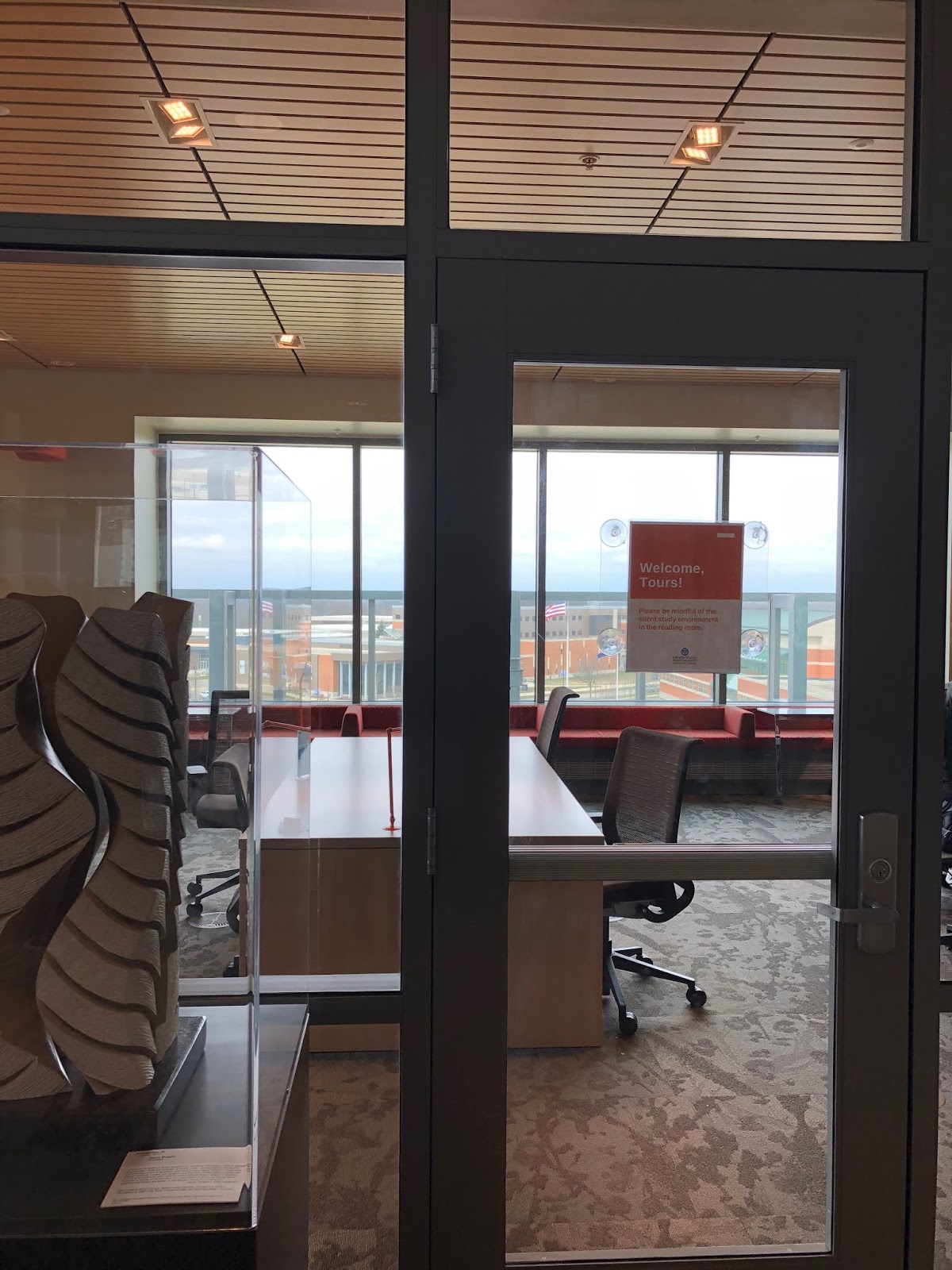
Assessing crowd levels can be a wonderful tool for people who may experience overstimulation in more populated settings. Students can also check out some of the library's "Focus Tools" to help with focus and self-regulation. Feedback generated from a neurodiverse student body, including a focus group of autistic GVSU students, initiated the circulation of these Tools, which include weighted lap pads, noise-canceling headphones, reading overlays, fidgets and more.
The Library is inclusive of all learning styles, providing a variety of seating arrangements depending on whether a person prefers studying alone, alone/together, quiet enclosed study rooms, or in larger group collaboration. Not pictured are also height-adjustable tables for library users who prefer or need to be working while standing, but may also be adjusted for seated users. An abundance of natural light is found throughout the library, along with refurbished wood interspersed to help absorb sound. Though we didn't notice until it was brought to our attention, a soothing white noise being projected on one of the levels to help mask collaborative sounds certainly succeeded in its task. Here are just a few of the many different seating arrangements we found:
Smaller 1 - 1 groupings
Cozy nooks with movable tables
Single seat enclosures with pull-out table tray
Quiet, natural respite found in the center courtyard of the Library
One of the silent study/reading rooms
Movable white boards and white board walls found in collaborative areas
More beautiful, natural respite found on the top level terrace
Popular meeting rooms can be reserved online.
There are so many other great examples, including the fantastic collaboration areas, which were all occupied by many students so I was not able to take photos. Hannah told us that the larger tables with 4 - 5 cozy chairs were the most popular seating arrangement, as students like to spread their books/materials out while working. You can check out more of these arrangements pictured on their website.
The Library's linear layout, interactive digital pedestal displays, text support, and large pop-out call letters in the browsable collections assist students of all abilities with independent wayfinding.
Students are also provided with creativity-sparking (and/or stress-relieving) toys in the large collaboration space.
Students can also head to the Knowledge Market to meet with highly-trained student peer consultants to work on their writing skills, presentation style, and researching strategies.
While humanities books and high-use books in the sciences and social sciences are out on the floor, the majority of the Library's books are housed in an automated storage/retrieval system which students and faculty can request online and pick up at the service desk within minutes. This space savings allows for more space dedicated to student needs. This amazing system is where we ended our tour.
As we left to collect our things, we observed students studying, researching, collaborating, creating, and socializing in a student-focused library. In addition to the incorporation of assistive technologies throughout the Mary Idema Pew Library, staff are constantly observing and evaluating how students of all abilities are using spaces and how their experience can be improved upon. A model of inclusion for all academic, public, special, and K-12 school libraries to take a look at.
Subscribe to:
Posts (Atom)